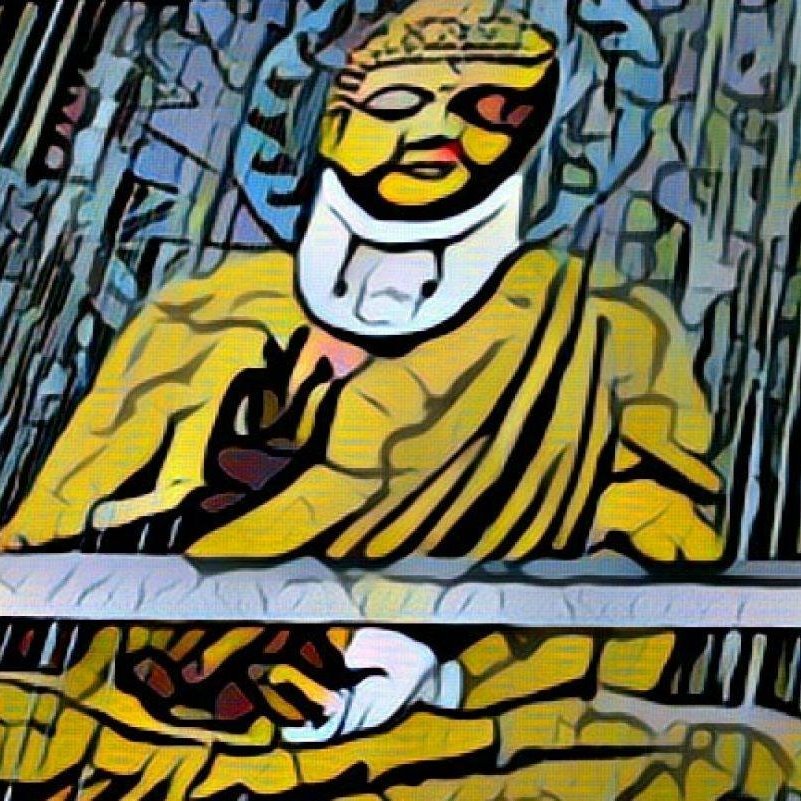
That image continues to inspire outrage and offence so I wanted to remind folks that it is a Banksy piece, he who is a fellow Bristolian. In the words of the Banksy Project, “The work shows Buddha with a bandaged hand and facial wounds to symbolise the triumph of the mind over emotion.” I like to think of it as the imperfect Buddha, something we will all forever be no mater how much we might strive to live up to the fantasies of perfection, complete and total enlightenment and the shedding of our humanity.
Look, I am a busy bee. I would rather not be but such is the way of 21st century life for the declining middle classes of which I am still part. Illness has not left me either and it takes up a lot of my attention and plays havoc on stable routines and productive plans. This is the contour that shapes my life these days so I do what I can with the resources I have available in terms fo time and energy.
I care for this podcast and would love to be able to do more. I want that to be clear to those who love it too and gain from its interviews and occasional think pieces and articles.
I am also working on a book project. It is slow going but very rewarding and it is taking the place of some of the creative output that used to grace these webpages.
That said, I have been creating podcast episodes despite not plugging them here. They are quite the divergent bunch, with old guests returning, new and unusual guests turning up, and the usual division between academics and teachers and practitioners being hosted.
Here is an overview of what you might have missed and what is coming up.
David McMahan on Rethinking Meditation
In our second interview with David, we discuss his newest book, Rethinking Meditation: Buddhist Meditative Practice in Ancient and Modern Worlds (Oxford UP, 2023) continues where Buddhist Modern left off. In this text David wakes readers up to context, and the role it has in the stories western Buddhists have constructed around meditation. As a religious studies professor and historian, David does this through reconstructing the history that has produced many of the ideas that are so prominent today regarding meditation and mindfulness. It’s a fascinating book and we go through key sections and concepts in our discussion.
This book is well worth your time if you, like us, take a critical approach to practice, results, and claims.
Perceiving Reality with Cristian Coseru
What does it mean to perceive and just how capable are we of perceiving reality? This is a core question in the work of Christian Coseru, who is today’s guest. He is the Lightsey Humanities chair and Professor of Philosophy at the College of Charleston. Christian works in the fields of philosophy of mind, phenomenology, and cross-cultural philosophy, especially Indian and Buddhist philosophy in dialogue with Western philosophy and cognitive science.
We discuss;
- Perceiving Reality and where current ongoing debates are on this immense topic.
- How confident we can be that phenomenological experience of reality is real and accurate.
- Where current theories are on the question of consciousness.
- The social role of cognition and the topic of mediation.
- What he makes of panpsychism andits return and relationship with physicalism.
- How such theories are represented in Buddhism.
- Working definitions of human flourishing and whether they are at all indebted to Buddhism.
- The question of Self, no-self without Buddhism.
Making Sense of Yogacara with William Waldron
Professor William Waldron teaches courses on the South Asian religious traditions of Hinduism and Buddhism, Tibetan religion and history, comparative psychologies and philosophies of mind, and theory and method in the study of religion at Middlebury College. His publications focus on the Yogacara school of Indian Buddhism and its dialogue with modern thought. He is the author of Making Sense of Mind Only: Why Yogacara Buddhism Matters (Wisdom Publications, 2023).
In this conversation, we look at Yogacara thought, idealism, constructivism and the impact on the practitioner and tackle the following;
- Why thinking of Yogacara as Mind Only is deeply problematic
- Why seeing Yogacara as essentially constructivist is more accurate
- Why seeing constructivism in dualistic terms is to miss the point
- Why interdependence is central to Yogacara rather than the doctrine of emptiness
- Why the signature concepts of; the three natures, the storehouse consciousness, and mere perception are liberational and key to understanding Yogacara’s ethics
- Why Madhyamaka became dominant and a mistaken view of Yogacara developed as a consequence
- How the insights of Yogacara can help us to understand concepts of liberation today
Building the Future Buddha with Jundo Cohen
Jundo Cohen is a Zen Buddhist teacher and founder of Treeleaf Zendo, a digital Zen community with members in over 50 countries. He writes on the intersection of Buddhism, ethics, science, and the future of the planet. He resides in Tsukuba, Japan’s “Science City”. He is the author of The Zen Master’s Dance: A Guide to Understanding Dogen and Who You Are in the Universe (Wisdom, 2020), and is co-host of The Zen of Everything podcast.
In this episode I speak to Jundo about his new book, Building the Future Buddha: The Zen of AI, Genes, Saving the World, and Travel to the Stars (Treeleaf, 2024). The conversation covers a wide range of topics related to the future and Buddhism with some fun utopian thought on the way and some disagreement that makes for an interesting exploration.
Jundo claims that tomorrow’s technologies will change Buddhism. AI and robotics, bio-engineering and physical enhancements, genetics and nano-implants, virtual reality and new media, medical miracles and manufacturing marvels, extended lifespans and expanded minds will make many of Buddhism’s most fabulous ideals potentially realizable.
Nietzsche Now! With Glenn Wallis
Nietzsche Now! Now? Really, you might ask. Isn’t he dead already? The Great Immoralist on the vital issues of our time. Hmm, how is that you might ask. Find out in this conversation with Glenn Wallis, returning guest and author of Nietzsche Now! We discuss the role Nietzsche might play today in helping all of us exit the culture war bubble and start to think again. For regular listeners, don’t worry, we do touch on Buddhism too!
The Press Release does much of the work in explaining the appeal of this book.
‘For readers both acquainted with and new to the writings of Friedrich Nietzsche, Nietzsche NOW! (Warbler Press, 2024) frames and explains Nietzsche’s thinking on topics of immediate contemporary concern and relevance. Wallis unpacks Nietzsche’s complex philosophy with a deft, empathetic, and brilliantly subtle analysis of the views of the Great Immoralist on democracy, identity, civilization, consciousness, religion, and other momentous topics.
Throughout, Wallis includes ample extracts from Nietzsche himself. Rather than skirting what is controversial or editing for easy consumption, Wallis invites readers to exercise a courageous curiosity that yields a rich, nuanced understanding of Nietzsche. He takes readers on a sometimes counter-intuitive, always revelatory journey to grasp the relevance of Nietzsche for our contentious times.
“Clearly written, relevant accounts are rare in the world of Nietzsche scholarship. Nietzsche NOW! is immensely readable. Our ‘now’ is as pessimistic as Nietzsche’s ‘now’ but Wallis guides us, through Nietzsche’s writings, towards coping with the same problems Nietzsche tackled, including truth, democracy, morality, and identity. The same problems but not the same. All now wear modern dress. Wallis’s deep knowledge of Buddhism feeds into the transfigurative nature of the Übermensch, the radical figure who realizes the possibility for personal and social change, the figure whom we can all—why not?—strive to become.” Sue Prideaux
Upcoming Episodes
There are four podcast episodes in the works.
First up is with Shodhin Geiman, Zen Abbot at Chicago Zen centre, recently retired philosophy professor at Valparaiso University and author of Alone in a World of Wounds. We look at the downside of engaged Buddhism and the problem in mixing politics, activism and Buddhism. This one should upset a few souls.
We have interviews lined up with professor Simone Kotva, author of Effort and Grace, On the spiritual exercise of philosophy. Professor Vesna Wallace on the kalachakra Tantra and a Great Feast conversation with Hannes Schumacher, post-doc at the University of Berlin on philosophy and mysticism, Buddhism, ayahuasca (of course), and being a free-spirited modern day intellectual practitioner and all round curious soul.
Finally
Thank you to all those who have sent in guest suggestions over the years, even the cranks and New Age guru suggestions have been welcome: they do bring a smile to my face and fond memories of the mad-hat 90s. If you have further suggestions, drop me a line.
 The Imperfect Buddha Podcast